Types of cellular respiration: There are two basic types of cellular respiration aerobic cellular respiration and anaerobic cellular respiration. Aerobic respiration requires the use of oxygen and anaerobic respiration which does not use oxygen. There are several types of anaerobic respiration, most familiar is a process called fermentation.
Aerobic respiration is the process by which ATP is produced by cells by the complete oxidation of organic compounds using oxygen . In aerobic respiration oxygen serves as the final electron acceptor, accepting electrons that ultimately come from the energy rich organic compounds we consume. Glucose is a common energy source for cells
Stages in Aerobic Respiration:
Aerobic Respiration takes place in three stages which are summarized here starting with the original glucose molecule.

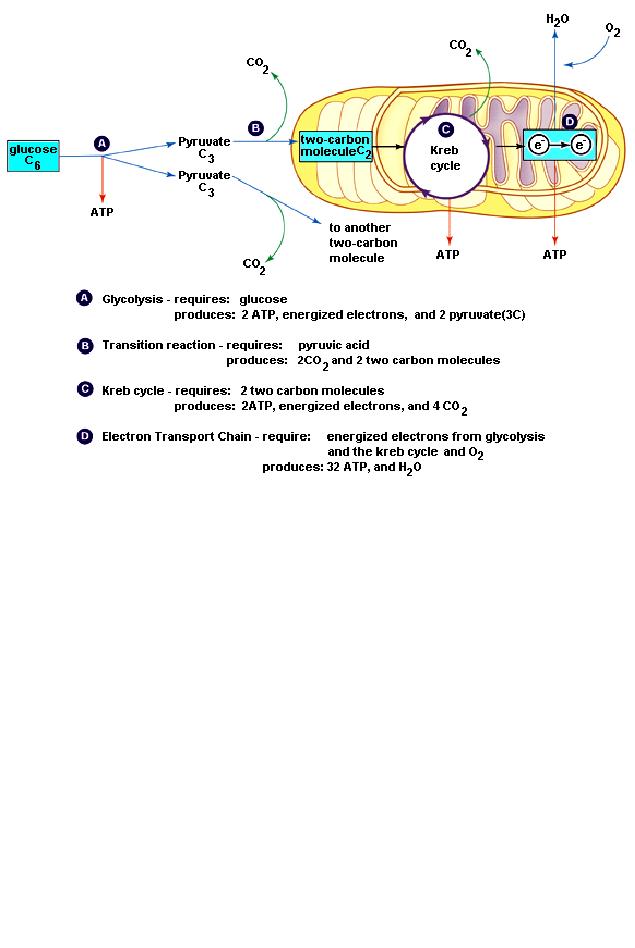
Glycolysis. Glycolysis is the first step in cellular respiration and all cells regardless of the type of cellular respiration they do are able to carry out glycolysis. Because of this we believe that glycolysis probably arose very early in the evolution of life on the planet. In glycolysis glucose is partially oxidized and broken down into two 3 carbon molecules called pyruvate or pyruvic acid. In the process, glycolysis produced 4 ATP for a net gain of two ATP and two molecules of NADH. ( the other 2 atp get put into this form to act as a carrier to collect those energy rich electrons) Each NADH is carrying two energy rich electrons away from the glucose and these electrons can be used by the cell to do work. ( Later in the electron transport system)
After glycolysis the pyruvate is processed to harvest 2 more NADH molecules and remove one carbon per pyruvate. The carbon and two oxygens is removed since it no longer has any useful energy. ( release CO2, a product of cellular respiration as it is waste.) This little step is the source of some of the carbon dioxide we produce.
**Note that glycolysis itself is anaerobic, in that oxygen is not required.
The remaining two carbons from the pyruvate feed into a complicated set of reactions called the Kreb’s Cycle. The Kreb's cycle produces 8 more NADH molecules and two molecules of FADH2. Again both of these are carrying energy rich electrons. Also 2 ATP molecules are produced.
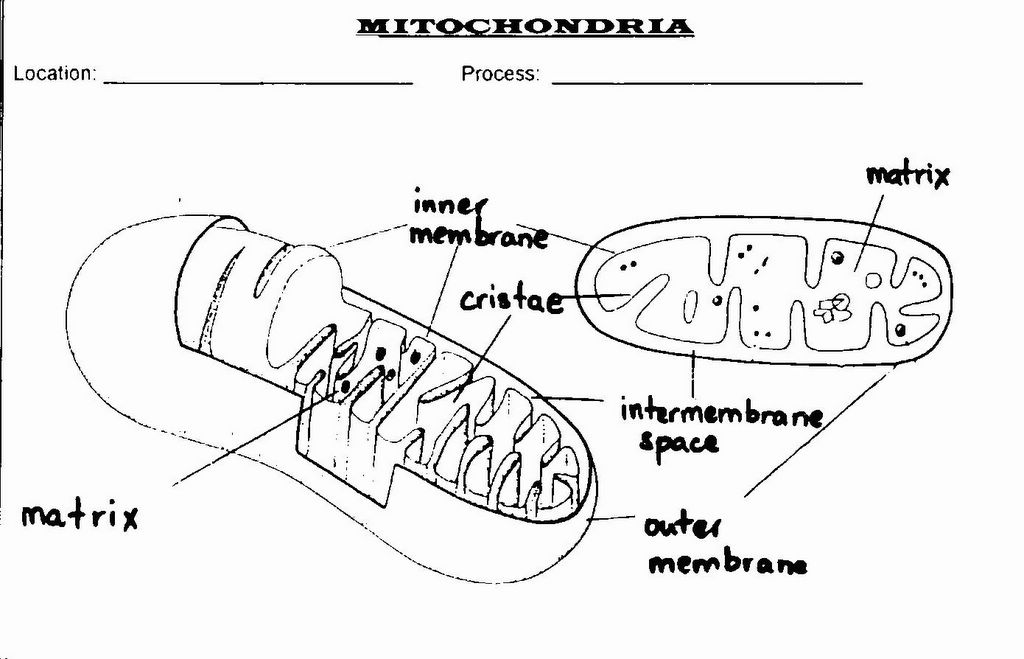
This occurs in the matrix of the mitochondria.
Electron transport phosphorylation. Most of the NADH and FADH2 travel to special membranes in the cell which have a series of molecules called theelectron transport system that harvest the energy rich electrons from the NADH and FADH2 and use that energy to make lots of ATP by a process called electron transport phosphosphorylation. If we are dealing with aerobic respiration this is where the oxygen becomes important. This occurs in the cristae of the mitochondria.
Role of oxygen in Aerobic Respiration. As the energy rich electrons from food are used to make ATP by electron transport phosphorylation they loose energy and once they are no longer useful they have to be removed. Oxygen is a great electron acceptor and so the electrons are combined with hydrogen ions and oxygen to make water. This prevents electrons from building up in the electron transport system. However, when there is a lack of O2 or the supply is deficient then the Kreb's cycle and E.T.S. cannot work and the cell undergoes a process known as fermentation.
In eukaryotic organisms aerobic respiration is compartmentalized. Glycolisis takes place in the cytoplasm and the Krebs’s cycle and electron transport taking place in the mitochondrion.
This is to help review cellular respiration. If you can answer these questions you know your stuff. Some are a little tricky, however I know you can answer them!
Glycolysis & Fermentation
1. What organisms trap sunlight & store it in carbohydrates?
2. What 2 organisms break down carbohydrates to release energy from cells?
3. What is the main energy currency of a cell?
4. Define cellular respiration.
5. What process begins cellular respiration & does it produce much ATP?
6. If there is no oxygen in cells, the products of glycolysis enter ________________________
pathways that yield no additional ______________________.
7. Fermentation is __________________________ because no oxygen is used.
8. If oxygen is present in cells, the glycolysis products enter the ______________________
respiration pathway.
9. Does aerobic respiration produce much ATP?
10. What simple sugar starts glycolysis?
11. In glycolysis, glucose is broken into 2 molecules of _______________________ acid
in the ______________________ of the cell.
12. In which part of the cell does fermentation occur? Is oxygen involved?
13. Name the 2 types of fermentation.
14. __________________________ acid fermentation helps make cheese & yogurt and also
occurs in _______________________ cells during heavy exercise.
15. What effect does lactic acid have on muscle cells?
16. Yeasts carry on what type of fermentation?
17. What alcohol is made in alcoholic fermentation?
21. Aerobic respiration requires what gas?
22. How much more ATP does aerobic respiration produce than glycolysis alone?
23. Name the 2 major stages of aerobic respiration.
24. What is completed in the Krebs cycle?
25. Which part of aerobic respiration makes most of the ATP (cell’s energy)?
26. Where does aerobic respiration take place in prokaryotes?
27. Where do these reactions take place in eukaryotes?


11 comments:
thanks for the notes mr.smith!
You are more than welcome Karen!
I am still going to write my unit test tomrorow right?
is the unit test still on monday?
Hahahah of course it is! Why would that change?
Just one more question. If buses are cancelled tomrorow will you still be going to school?
Yeah, Mr. Smith, If the buses are cancelled for tomorrow what am I supposed to do about my test? And what did I miss today that I need to know for the test?
hey mr. smith
im gonna try to make it to school tomorrow, as long as i dont get worse
i was just wondering if there was anyway that i could come in tomorrow morning to do a bit of catch up
i got all the notes from the blog, but i dont know what i should have ready
if i get sicker and dont manage to come, elyse told me she was interested in going in to get some help so she will be there
thanks
Erika, Lindsay, and Emily, if buses are canceled the school will still be open like it was today. I will be there with your tests so don't worry you girls just keep studying tonight so you can do amazing on the unit test..
Step, sure come in early I will be there in our class at 8am. Elyse if you still need the help again I ma there at 8am.
okay! sounds good. thank you!
Hey Mr. Smith
Did you get my lab this morning?
I slid it under the workroom door around 7:15.
Thank you for letting me hand it in?
-Sam
Post a Comment